Géométrie dans l'espace (partie 2) : Produit scalaire, orthogonalité et distances
Cours
Produit scalaire dans l’espace
Soient deux vecteurs \(\overrightarrow{AB}\) et \(\overrightarrow{AC}\). On note \(H\) le projeté orthogonal de \(C\) sur la droite \((AB)\).
- \(\overrightarrow{AB}\cdot\overrightarrow{AC} = AB \times AH\) si l’angle est aigu ;
- \(\overrightarrow{AB}\cdot\overrightarrow{AC} = -AB \times AH\) si l’angle est obtus.
Propriétés
- \(\overrightarrow{u}\cdot\overrightarrow{v} = \|\overrightarrow{u}\|\,\|\overrightarrow{v}\|\,\cos(\overrightarrow{u},\overrightarrow{v})\)
- \(\overrightarrow{u}\cdot\overrightarrow{v} = \overrightarrow{v}\cdot\overrightarrow{u}\)
- \(\overrightarrow{u}\cdot(\overrightarrow{v}+\overrightarrow{w}) = \overrightarrow{u}\cdot\overrightarrow{v} + \overrightarrow{u}\cdot\overrightarrow{w}\)
- \((\lambda\overrightarrow{u})\cdot(\mu\overrightarrow{v}) = \lambda\mu(\overrightarrow{u}\cdot\overrightarrow{v})\)
- \(\overrightarrow{u}\cdot\overrightarrow{v} = \frac12(\|\overrightarrow{u}\|^2+\|\overrightarrow{v}\|^2-\|\overrightarrow{u}-\overrightarrow{v}\|^2)\)
- \(\overrightarrow{u}\cdot\overrightarrow{v} = \frac12(\|\overrightarrow{u}+\overrightarrow{v}\|^2-\|\overrightarrow{u}\|^2-\|\overrightarrow{v}\|^2)\)
- \(\overrightarrow{u}\cdot\overrightarrow{v} = \frac14(\|\overrightarrow{u}+\overrightarrow{v}\|^2-\|\overrightarrow{u}-\overrightarrow{v}\|^2)\)
Produit scalaire dans un repère orthonormé
Dans un repère orthonormé \((O;\vec{i},\vec{j},\vec{k})\), on a :
\[ \vec{i}\cdot\vec{j} = \vec{i}\cdot\vec{k} = \vec{j}\cdot\vec{k} = 0. \]
Si \[ \overrightarrow{u} = \begin{pmatrix} x \\ y \\ z \end{pmatrix}, \qquad \overrightarrow{v} = \begin{pmatrix} x' \\ y' \\ z' \end{pmatrix}, \] alors :
\[ \overrightarrow{u}\cdot\overrightarrow{v} = xx' + yy' + zz'. \]
Orthogonalité
- \(\overrightarrow{u}\perp\overrightarrow{v} \iff \overrightarrow{u}\cdot\overrightarrow{v}=0\)
- Un vecteur \(\overrightarrow{n}\) est normal à un plan \(\mathcal{P}\) si \(\overrightarrow{n}\cdot\overrightarrow{p}=0\) pour tout vecteur \(\overrightarrow{p}\) du plan.
- Soient $\overrightarrow{n_1} $ un vecteur normal au plan \(\mathcal{P}_1\) et $\overrightarrow{n_2} $ un vecteur normal au plan \(\mathcal{P}_2\). Les deux plans \(\mathcal{P}_1\) et \(\mathcal{P}_2\) sont orthogonaux si \(\overrightarrow{n_1}\cdot\overrightarrow{n_2}=0\).
Exemple
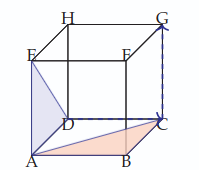
Dans le cube ABCDEFGH : \(\overrightarrow{CG}\perp\overrightarrow{DC}\). Les plans (ABC) et (ADE) sont donc perpendiculaires.
Distance entre deux points
Pour \(A(x_A,y_A,z_A)\) et \(B(x_B,y_B,z_B)\) :
\[ AB = \sqrt{(x_B-x_A)^2 + (y_B-y_A)^2 + (z_B-z_A)^2}. \]
Équation cartésienne d’un plan
Un plan de vecteur normal \[ \overrightarrow{n} = \begin{pmatrix} a \\ b \\ c \end{pmatrix} \] a pour équation :
\[ ax + by + cz + d = 0. \]
où \(d = -(ax_A + by_A + cz_A)\).
Distance d’un point à un plan
Pour un plan \(ax+by+cz+d=0\) et un point \(A(x_A,y_A,z_A)\) :
\[ d(A,\mathcal{P}) = \frac{|ax_A + by_A + cz_A + d|} {\sqrt{a^2 + b^2 + c^2}}. \]
7. Liens utiles
Exercices Corrigés
QCM notés
QCM d'entraînement
Commencer l'entraînementExercices interactifs
Une série d'exercices avec correction immédiate, à volonté.
Commencer les exercices